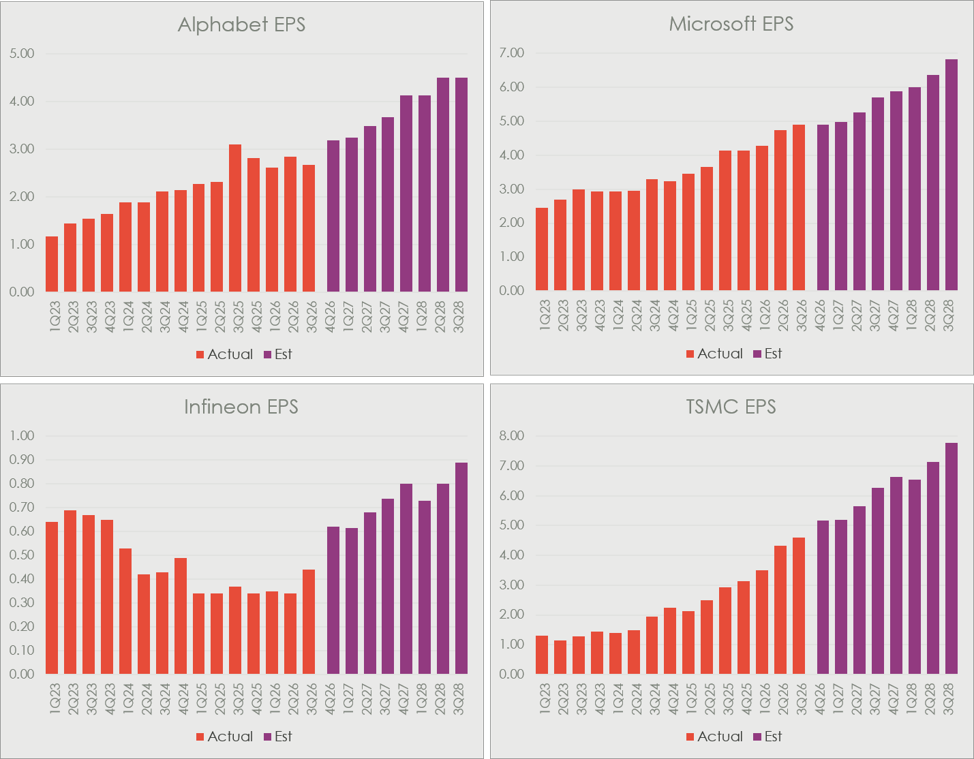
We have seen a tumultuous week for tech stocks. First, we had Alphabet tumble 20% in two days after they reported third quarter results that disappointed high expectations, followed by more volatility on the back of concerns over the regulatory environment in the face of a Democrat clean sweep in the midterms.
We have been fielding a lot of calls from clients.
The central question is not whether tech shares have fallen, but whether the investment case has changed. Our approach is to distinguish price volatility from changes in fundamentals, reassess valuations and conviction, and manage position sizes accordingly. This report explains that approach and illustrates it through our experience with Infineon.
During volatile times like this it is important to take a step back and remember Warren Buffet’s famous quote, “In the short run, the market is a voting machine. In the long run, it is a weighing machine.”
The Tech trade has been increasingly crowded over the last 18 months as growth in data center investment drove earnings growth through the roof. This crowded space creates an increasingly unstable system that has the potential to exacerbate stock movements, as margin calls and algorithmic trades widen the amplitude of price swings.
As long-term valuation-driven investors, it is important to take a step back and understand your investment principles and not get dragged into indiscriminate selling.
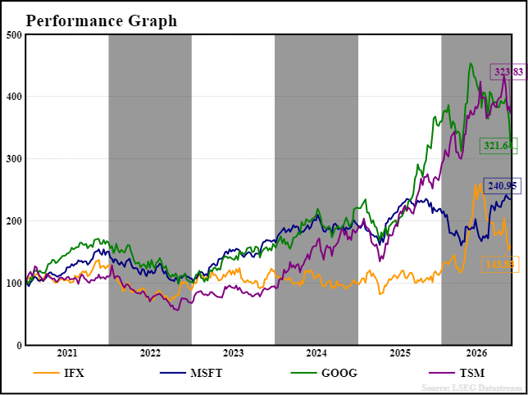
Over the last 5 years tech names have seen tremendous returns, up between 150-325%, despite this recent pullback.
Our active portfolio-management process continually reassesses three questions: how strongly we believe in the investment case, whether our exposure is appropriate, and whether the share price justifies adding to or reducing the position. We consider whether a stock has risen too quickly and warrants profit-taking or has it fallen far enough to justify additional investment. These questions remain central to our ongoing review of every holding.
Portfolio management is a dynamic process that involves maintaining the delicate balance of holding enough exposure to a particular stock so that the portfolio return benefits from the upside, while being careful not to be overexposed, which puts the portfolio at risk should we get a big drawdown in the stock.
This process means we are also nipping and tucking – adding more to our position when we feel the stock has pulled back for no fundamental reason or taking some profits when we feel the stock has run a bit ahead of itself.
By way of example, we look at our trading decisions of Infineon (IFX); one of our favourite ideas over the last 2 years.
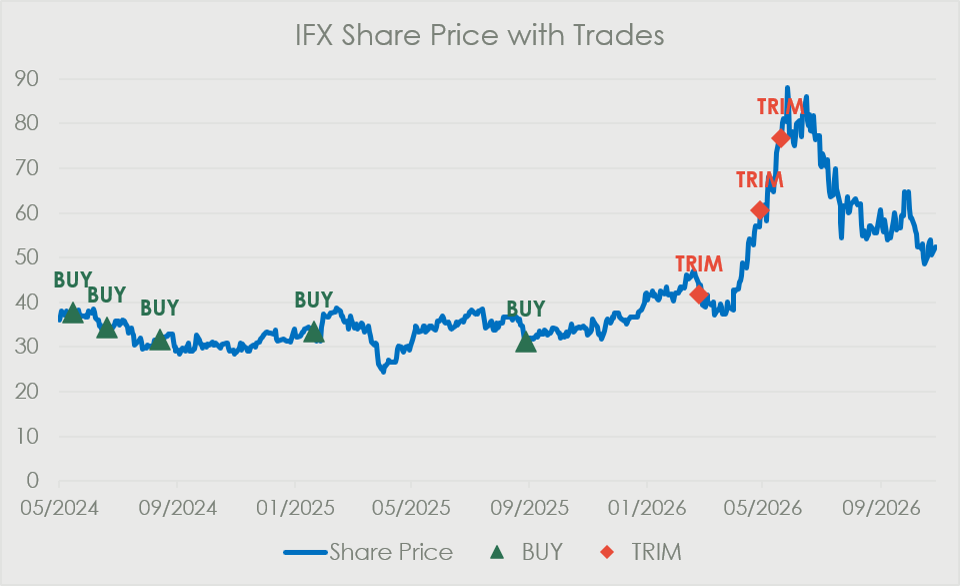
You will note that we entered the position in May 2024, after which the stock trended downward for six months. We continued to add to our position as the fundamentals became increasingly attractive. The stock began to gain momentum in May 2025. As the stock took off in 2026, our holding kept moving above the top end of our holding range, and we consequently took profits on several occasions while maintaining our preferred portfolio weight in the name.
Our Infineon example starts with an investment of $10,000. Between April and July 2026, we took $9,000 in profits out of the position, while retaining $6,500 of exposure, representing 5% of the portfolio. We estimate that without those trims, the original $10,000 position would now be worth $13,600. These figures illustrate the effect of position management.
Looking at the tech space in general, despite the solid run-up over the last few years, valuations continue to be very reasonable, even more so after the recent price moves.
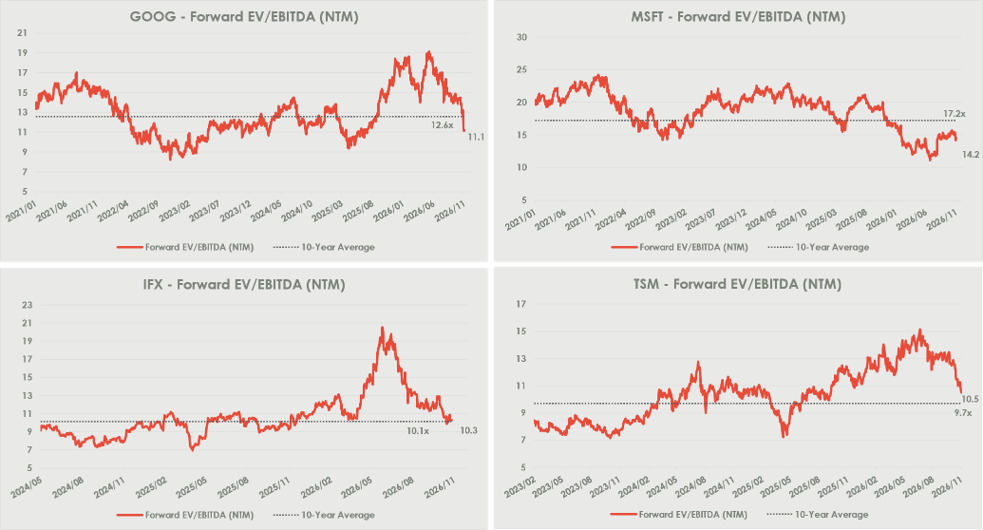
At the same time that valuations have pulled back, we have continued to see an increase in earnings growth expectations. While there remains a lot of moving parts with regards to the development of AI and the data center buildout – specifically surrounding the ability to achieve adequate returns on the huge capital investment and ability to fund projects – the big tech names are looking attractive again.